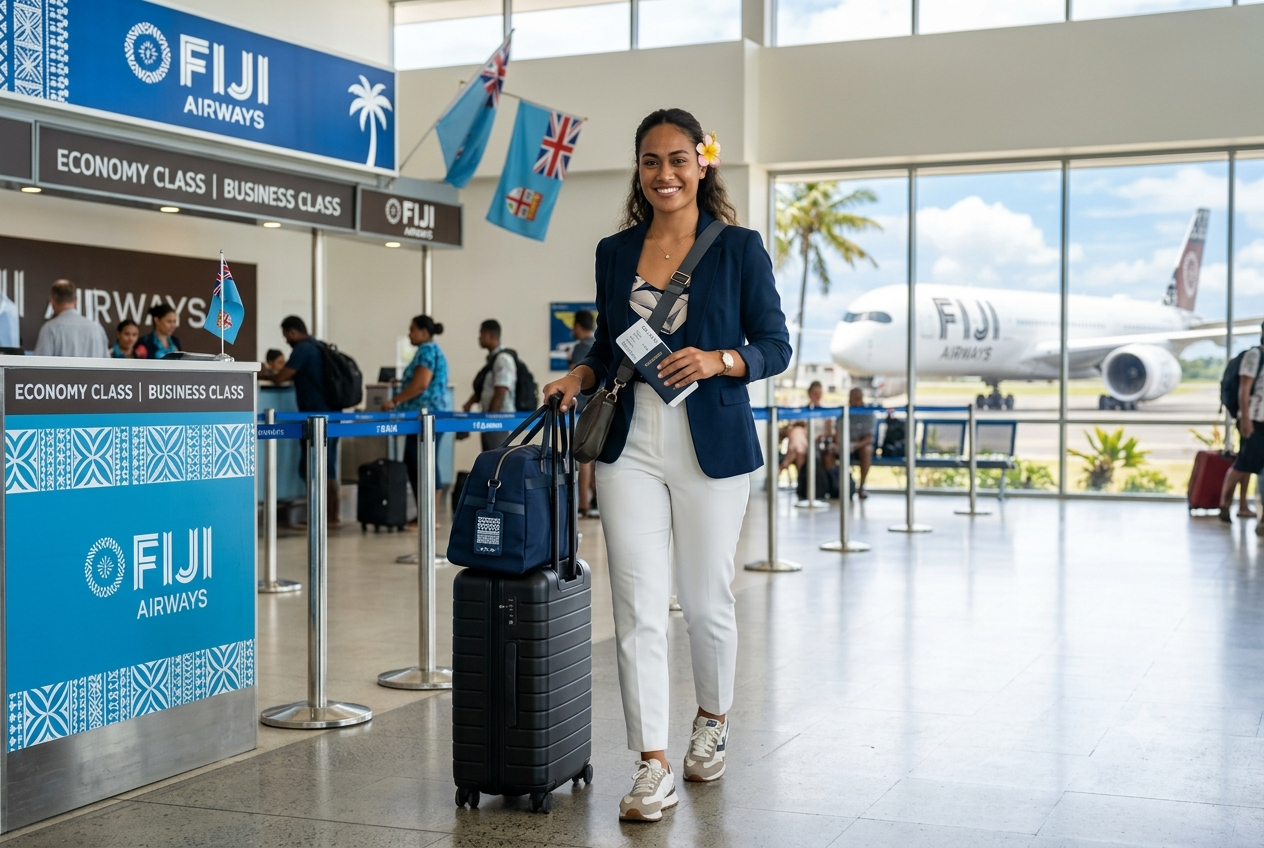
Understanding the Fiji Airways Baggage Policy before your trip can save you money, prevent airport delays, and help you pack with confidence. Whether you're flying within the South Pacific or traveling on long-haul routes such as Nadi to Sydney, Auckland, Los Angeles, Tokyo, or Hong Kong, knowing the latest baggage rules makes every journey smoother. This guide explains carry-on luggage, checked baggage, excess baggage charges, special baggage, prohibited items, and practical travel tips based on the latest airline policy updates applicable for 2026. If you need personalized travel assistance, you can also speak with a travel expert at +1-833-894-5333.
Why Understanding the Fiji Airways Baggage Policy Matters
Every airline has different baggage rules depending on fare type, destination, and cabin class. Spending a few minutes reviewing baggage regulations before departure can help you avoid unexpected costs at the airport.
Key points to remember:
Baggage allowance varies by fare class and route.
Carry-on and checked baggage have separate limits.
Oversized and overweight bags usually incur additional charges.
Special items require advance planning.
Some dangerous goods are prohibited in both cabin and checked baggage.
International itineraries may follow different baggage agreements than domestic flights.
Carry-On Baggage Allowance
The Fiji Airways carry-on baggage rules allow passengers to bring essential belongings into the cabin while maintaining safety and comfort for everyone onboard.
General cabin baggage guidelines include:
Economy passengers receive a standard cabin baggage allowance.
Business Class travelers generally receive a higher allowance.
One personal item is allowed alongside the main cabin bag.
Cabin baggage must fit safely in the overhead compartment.
Personal items should fit beneath the seat in front of you.
Typical personal items include:
Laptop bags
Small handbags
Camera bags
Compact backpacks
Duty-free shopping bags
Small diaper bags
Travel Tip
Keep medications, travel documents, electronics, chargers, valuables, and one change of clothing inside your carry-on luggage in case your checked baggage arrives later.

Checked Baggage Allowance
The Fiji Airways checked baggage allowance depends on several factors, including:
Fare purchased
Cabin class
Destination
Frequent flyer status
Codeshare partner airlines
Generally, passengers receive a complimentary checked baggage allowance on many international routes.
Important points include:
Economy fares may include one or more checked bags depending on the route.
Business Class passengers usually receive a more generous baggage allowance.
Weight restrictions apply to every checked bag.
Multiple bags may be accepted as long as total allowance is not exceeded.
Some promotional fares may include reduced baggage benefits.
Always attach identification tags to every checked suitcase before arriving at the airport.
Personal Item Rules
Besides cabin baggage, travelers may bring one personal item for convenience during the flight.
Common acceptable personal items include:
Small purse
Laptop case
Tablet bag
Briefcase
Infant diaper bag
Small backpack
To avoid boarding delays:
Keep the personal item compact.
Store it beneath the seat.
Remove laptops during security screening if requested.
Avoid overpacking smaller bags.
Baggage Size and Weight Limits
Understanding Fiji Airways baggage allowance, Fiji Airways baggage size limit, and Fiji Airways baggage weight requirements helps prevent expensive surprises during check-in.
Travelers should always verify:
Maximum dimensions for cabin baggage.
Maximum weight for carry-on luggage.
Individual bag weight limits.
Total checked baggage allowance.
Oversized baggage measurements.
If a suitcase exceeds the permitted weight or dimensions, additional fees may apply before boarding.
Practical Example
A traveler flying from Nadi to Sydney with two large suitcases should weigh both bags at home. Even if only one bag exceeds the airline's weight limit, excess baggage charges may apply at check-in.
How to Purchase Extra Baggage
Buying additional baggage before departure is usually the most economical option.
Step-by-Step
Review your ticket's included baggage allowance.
Estimate the total weight of your luggage.
Purchase additional baggage before airport check-in whenever available.
Print or save your updated booking confirmation.
Arrive early if carrying oversized luggage or special baggage.
If you need booking assistance or baggage-related guidance, experienced travel advisors can be reached at +1-833-894-5333.
New User Flight Booking Discounts
Planning ahead can reduce both airfare and baggage expenses.
Many online travel platforms occasionally offer New User Flight Booking Discounts, allowing eligible first-time users to save up to 50% off flights. Booking early with these promotions may leave more room in your travel budget for prepaid baggage, seat selection, or travel insurance.
Excess, Overweight, and Oversized Baggage Fees
One of the biggest travel expenses comes from unexpected baggage charges.
The Fiji Airways excess baggage fees depend on factors such as:
Extra pieces
Overweight bags
Oversized luggage
Route
Airport where payment is made
Passengers can often reduce costs by purchasing additional baggage before arriving at the airport.
Common situations that generate extra fees include:
Bags heavier than permitted
Additional checked suitcases
Surfboards or sporting gear
Large musical instruments
Extra luggage beyond ticket allowance
Packing efficiently before departure is usually much cheaper than paying airport baggage rates.
Special Baggage Policy
Many travelers carry equipment requiring special handling.
Sports Equipment
The Fiji Airways sports equipment policy generally accommodates many sporting items, subject to applicable conditions.
Examples include:
Golf clubs
Surfboards
Bicycles
Fishing gear
Diving equipment
Snow sports equipment
Travelers should:
Use protective cases.
Pack equipment securely.
Check route-specific restrictions.
Notify the airline if required.
Musical Instruments
Musicians can travel with instruments depending on size.
Options may include:
Carrying smaller instruments in the cabin.
Purchasing an additional seat for valuable instruments.
Checking larger instruments using protective hard cases.
Medical Devices
Passengers requiring medical equipment should travel comfortably by preparing in advance.
Helpful recommendations:
Carry medical documentation.
Pack essential medications in cabin baggage.
Confirm battery requirements for medical devices.
Arrive early for security screening.
Infant and Child Baggage Policy
Families traveling with young children should understand baggage allowances before departure.
Infant travel may include allowances for:
Strollers
Baby bassinets (where available)
Diaper bags
Child safety seats
Essential baby supplies
Parents should pack:
Extra clothing
Baby food
Bottles
Medicines
Wet wipes
Having these items inside your carry-on helps during long international journeys.
Restricted and Prohibited Items
Certain items are restricted for safety reasons.
Examples include:
Explosives
Fireworks
Flammable liquids
Fuel
Toxic chemicals
Compressed gas cylinders
Corrosive materials
Items requiring additional attention include:
Lithium batteries
Power banks
Electronic cigarettes
Smart luggage
Sharp objects
Always review security regulations before packing to avoid delays at the airport.
International vs Domestic Baggage Rules
International routes often have different baggage policies than shorter regional flights.
When comparing baggage allowances, travelers should consider:
Destination country regulations.
Customs inspections.
Transit airport requirements.
Partner airline baggage agreements.
Fare-specific baggage inclusions.
For example:
Nadi–Los Angeles
Nadi–Singapore
Nadi–Hong Kong
Nadi–Auckland
may include baggage allowances that differ from shorter regional services within the South Pacific.
Connecting Flight Baggage Policy
Passengers with connecting flights should understand which airline's baggage policy applies.
Important considerations include:
Through-checked baggage availability.
Codeshare agreements.
Separate tickets.
Customs clearance during transit.
Final baggage collection point.
Example
A traveler flying Brisbane–Nadi–Los Angeles may have baggage checked through to the final destination depending on the booking and airline agreements. Always confirm this during check-in.
New User Flight Booking Discounts
Smart travelers often combine discounted airfare with prepaid baggage.
Eligible first-time users on selected booking platforms may receive up to 50% off flights through New User Flight Booking Discounts. Using these savings wisely can help offset baggage costs, especially for long international vacations.
Tips to Avoid Excess Baggage Charges
Following a few practical strategies can save both time and money.
Helpful recommendations:
Weigh luggage before leaving home.
Use lightweight suitcases.
Wear heavier clothing instead of packing it.
Share baggage allowance when permitted.
Prepay additional baggage online.
Avoid packing prohibited items.
Keep valuables in carry-on baggage.
Label every suitcase clearly.
Arrive early for oversized baggage processing.
Review the Fiji Airways luggage rules before every trip.
If you have questions about baggage planning, itinerary changes, or booking support, assistance is available at +1-833-894-5333.
Baggage Fees by Fare Type
Different fare families may include different baggage benefits.
- Economy Lite
- Carry-on: Standard cabin baggage allowance
- Checked baggage: May be limited or not included on some fares
- Flexibility: Lowest fare flexibility
- Economy Value
- Carry-on: Standard cabin baggage allowance
- Checked baggage: Included on many routes
- Flexibility: Moderate flexibility
- Economy Flex
- Carry-on: Standard cabin baggage allowance
- Checked baggage: Higher or more flexible allowance depending on the route
- Flexibility: Greater ticket flexibility
- Business Class
- Carry-on: Higher cabin baggage allowance
- Checked baggage: Increased checked baggage allowance
- Flexibility: Premium flexibility and travel benefits
Always verify your ticket details before travel because allowances vary by route and fare purchased.
What Happens at Fiji Airways Baggage Claim?
The Fiji Airways baggage claim process is generally straightforward.
Upon arrival:
Follow baggage claim signs.
Check carousel information displays.
Compare baggage tags before leaving.
Report delayed or damaged baggage immediately.
Keep your baggage receipts until the trip ends.
Prompt reporting makes it easier to trace delayed luggage.
Comparing Fiji Airways with Other Major Airlines
While every airline has different baggage policies, Fiji Airways remains competitive for travelers flying across the Pacific.
- Fiji Airways
- Carry-on: Depends on fare and route
- Checked baggage: Included on many international fares
- Sports equipment: Accepted under applicable conditions
- Qantas
- Carry-on: Depends on fare and cabin class
- Checked baggage: Route-specific allowance
- Sports equipment: Accepted according to airline policy
- Air New Zealand
- Carry-on: Varies by fare type
- Checked baggage: Included on many international fares
- Sports equipment: Accepted with applicable conditions
- Singapore Airlines
- Carry-on: Based on cabin class
- Checked baggage: Generous allowance on many international routes
- Sports equipment: Accepted according to baggage regulations
- Virgin Australia
- Carry-on: Depends on fare purchased
- Checked baggage: Route and fare dependent
- Sports equipment: Accepted subject to airline guidelines
Always compare baggage allowances before booking, especially if traveling with multiple suitcases or sporting equipment.
Travel Scenario
Imagine a family traveling from Los Angeles to Nadi for a tropical holiday.
Parents pack one checked suitcase each, while children share lightweight luggage. Surfboards are packed in protective travel bags, and important medications remain inside cabin baggage. They purchase additional baggage online before departure and take advantage of a New User Flight Booking Discount that saves up to 50% on airfare. Because they planned ahead, they avoid airport surprises and begin their vacation stress-free.
Important Disclaimer
We are an independent travel assistance agency, not officially affiliated with any airline, but here to help you with your travel queries and support you every step of the way. Group Tripo provides general travel information and assistance to help travelers better understand airline policies.
Frequently Asked Questions
Who can help with baggage or booking questions?
If you need general travel assistance regarding baggage, itinerary changes, or booking support, you can contact experienced travel advisors at +1-833-894-5333.
What is the baggage limit for Fiji Airways?
The baggage limit for Fiji Airways depends on your fare, cabin class, and destination. Most international Economy fares include 23 kg of checked baggage, while Business Class generally includes 30 kg. Cabin baggage is typically limited to 7 kg, and no checked bag may exceed 30 kg in weight.
How much weight baggage is allowed in flight 2026?
In 2026, Fiji Airways generally allows Economy passengers up to 23 kg of checked baggage on international flights, while Business Class passengers receive up to 30 kg. Cabin baggage is usually limited to 7 kg. Exact allowances vary by route, fare type, and ticket conditions, so checking your booking is recommended.
How much does Fiji Airways charge for checked baggage?
Fiji Airways charges checked baggage fees based on your route, fare type, and whether you exceed the included allowance. Extra, overweight, oversized, or bulky baggage such as surfboards and golf clubs attracts additional charges. Purchasing extra baggage before arriving at the airport is usually more economical than paying at check-in.
How strict is Fiji Airways with baggage
Fiji Airways generally enforces its baggage rules, especially for cabin baggage weight, checked baggage weight, and size limits. Bags may be weighed during check-in, and excess or oversized luggage can incur additional fees. Following the published baggage allowance and packing within limits helps avoid delays and unexpected charges.
Read More - Can You Cancel an El Al Flight Without Extra Fees?
Conclusion
Understanding the Fiji Airways Baggage Policy before you fly helps you avoid unnecessary expenses, comply with baggage regulations, and enjoy a smoother airport experience. Whether you're traveling with cabin baggage, checked luggage, sports equipment, infant supplies, or oversized items, planning ahead makes every journey easier. Review your fare's baggage allowance, pack according to airline guidelines, and consider purchasing extra baggage before departure to save money. Travelers looking for additional booking guidance or general travel assistance can also reach Group Tripo at +1-833-894-5333 for support with their travel plans.